

How does an EV bypass work?
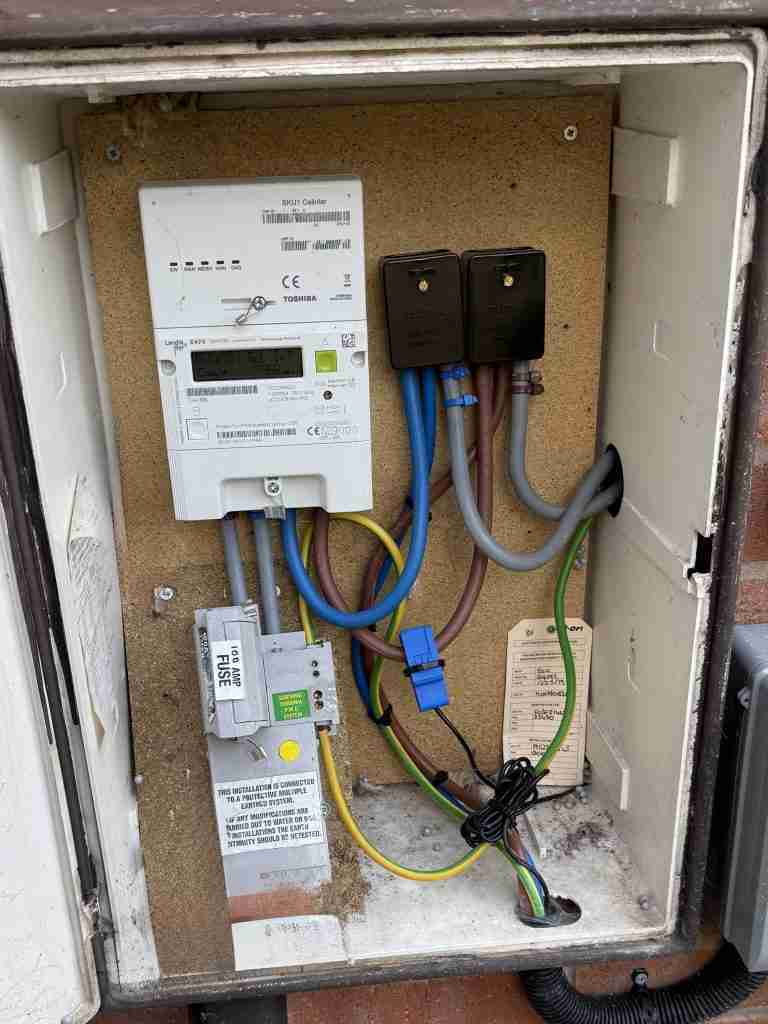
On a suitable installation, we arrange the EV charger’s supply separately from the household circuits monitored by the battery.
The battery’s monitoring sensor—often called a CT clamp—then measures household demand without including the charger. In normal operation, the battery continues supplying your home without increasing its output to cover car charging.
This type of supply separation and sensor positioning is also described in myenergi’s installation guidance.
The electricity meter still records your grid use as normal. The “bypass” refers to the battery’s monitoring arrangement.
What does Electrical Innovations do?
We start by checking your EV charger, inverter, battery and existing wiring. We look at where the charger is supplied from, where the monitoring sensors are fitted and how you currently manage charging.
Where a bypass is suitable, we adjust the supply arrangement and battery monitoring, then test how the system behaves when the car charges.
We also check the charger’s load-management controls and any relevant solar, backup or export-limiting functions. Moving a sensor needs to be considered as part of the whole installation.
A separate EV consumer unit usually makes things easier
If your charger already has its own separate consumer unit—the small fuse box serving the charger—the work is often straightforward.
The charger and household supplies may already be separated in a convenient location, making it easier to adjust what the battery monitors.
We still need to check how that consumer unit is connected. Having a separate box is helpful, but its supply arrangement determines what changes are needed.
A charger connected to the main house consumer unit can be more difficult
If your EV charger is wired into the main household consumer unit, its demand may be measured together with all your other household circuits.
Separating it can require more substantial wiring changes, including a new cable from a suitable separate supply point to the charger.
The difficulty depends on the location of the equipment and the available cable routes.
Why some new builds are particularly tricky
In some new-build homes, the charger is connected to a consumer unit in the middle of the house. Its cable may run behind finished walls or beneath floors.
In that situation, creating a separate supply can be difficult. A new cable might need to run through the property or follow an alternative route outside.
A bypass may still be possible, but the disruption and cost need to be weighed against the alternatives. We’ll explain the practical options before recommending the work.

What if a simple bypass isn’t possible?
There are three main approaches.
1. Rewire the car charger onto a separate supply
Where appropriate, we can fully rewire the charger’s supply so it can be excluded from the battery’s household-demand monitoring.
This provides a physical solution that doesn’t rely on coordinating charging times. The work involved depends on the route available for the new cable.
2. Manage the car and battery with charging schedules
It may be possible to prevent battery drain by setting the home battery not to discharge during the car’s charging period.
The important point is that this must cover the entire EV charging session. Simply starting both batteries charging together may not be enough: if the home battery fills first, it could resume discharging while the car is still charging. Ohme’s guidance explains this interaction between EV charging and home batteries.
If your tariff automatically varies the car’s charging times, a fixed battery schedule may not cover every session.
3. Use compatible third-party apps or automation
Some systems can be coordinated through compatible third-party apps or home-energy automation.
For example, an automation may pause home-battery discharge when EV charging starts and restore normal operation afterwards.
This can avoid extensive rewiring, but compatibility varies. It also relies on the controls and connections between your devices working reliably.
Can I still charge my car from solar?
Potentially, yes. Preventing the car from draining stored battery energy does not automatically mean losing the ability to use surplus solar.
However, the result depends on your charger, inverter and monitoring arrangement. We’ll check how your system handles surplus solar and explain how any proposed changes would affect it.
Do I need an EV bypass rewire?
Not every installation needs one. Your existing equipment may already have suitable controls, or a change to settings may solve the problem.
If you notice your home battery dropping whenever the car charges, it’s worth checking—particularly if you intended to charge the car from cheap grid electricity and save the battery for your home.


