

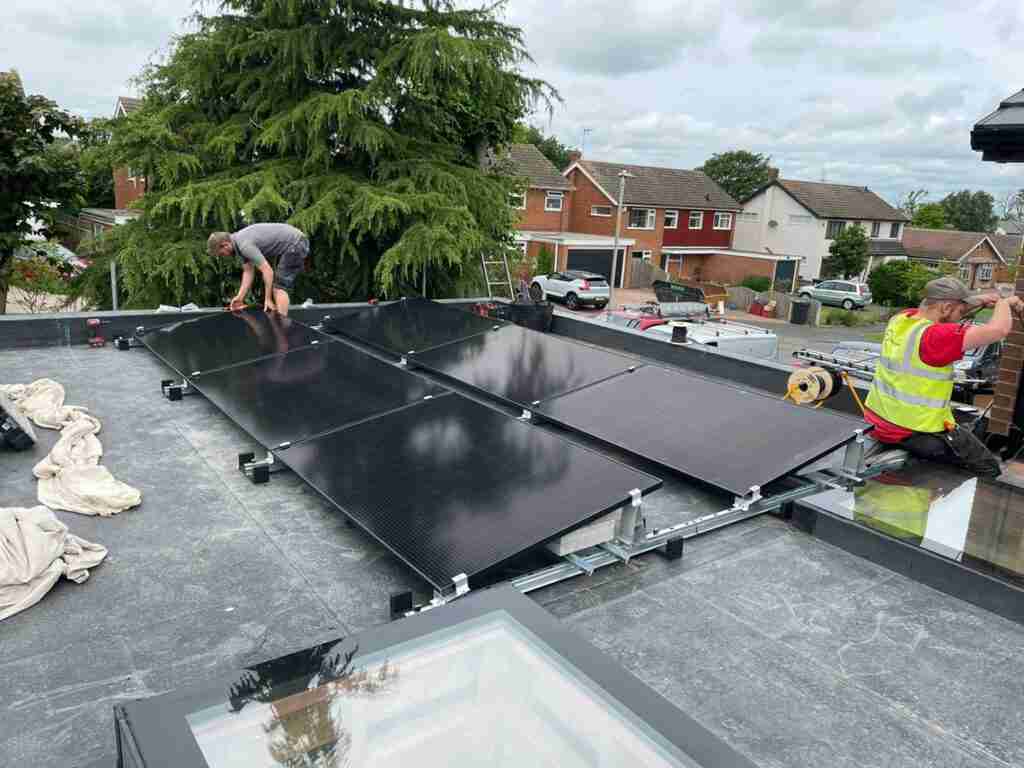
You’d love to install solar panels to help bring down your monthly energy bills. Unfortunately, the only space your home has available is a flat roof, and nobody installs solar panels lying flat, right?
Well, yes. But the thing is, you can absolutely install solar panels on a flat roof, provided the roof is in suitable condition and you design the system carefully. In fact, a flat roof can sometimes offer more flexibility than a pitched roof. We’ll explain more about that below.
Of course, a flat-roof solar installation isn’t simply a case of placing panels on top of the roof and hoping for the best. There are lots of things to consider, but a flat roof certainly isn’t a dealbreaker.
On this page, our team at Electrical Innovations walks you through the basics of installing solar panels on a flat roof.
How are solar panels fitted to a flat roof?
Solar panels are fitted to angled mounting systems, frames which are usually set at around 10 to 15 degrees on a flat roof. This helps the panels capture sunlight efficiently while allowing rainwater to run off and drain away.
This is why a flat roof can be even more advantageous than a pitched roof. With adjustable and customisable mounting systems, your installer can tailor the panel angle and direction to your home. On a ‘normal’ roof, the angle and positioning of the roof itself largely determine those factors.
Depending on your roof and building, the mounting system may be:
- ballasted, using calculated weight to secure the array
- mechanically fixed to the structure beneath the roof covering
- designed as a combination of both
A good solar panel mounting system design shouldn’t compromise the roof’s membrane, overload the structure weight-wise, or create avoidable drainage issues.
What needs checking before installing solar panels on a flat roof?
If you’re looking to install solar panels on a flat roof, here are the things to consider:
The roof’s condition and remaining life
Before designing the system, we’ll assess the roof covering, signs of water ingress, drainage outlets, existing repairs and the expected remaining life of the roof. Solar panels are designed to remain in place for many years, so it rarely makes sense to install them on a roof that needs replacing.
Structural capacity and wind loading
The mounting method, panel spacing, edge distances and ballast calculations all need to be based on the individual property. A flat-roof solar array adds weight to the building. That includes the panels, mounting system, ballast where used, cabling and associated equipment. In some cases, the roof may need to be reinforced or the solar array may need to be smaller.
The design must also account for wind uplift. Solar panels can act like sails in exposed conditions, particularly on taller buildings or roofs with little surrounding shelter.
Layout, shading and panel spacing
Flat roofs give us flexibility, but they also require careful spacing.
For example, your design should ensure your panels aren’t packed together so tightly that one row shades another when the sun is lower in the sky. On the other hand, spreading panels too far apart can waste usable roof space.
On one of our projects in Barrow upon Trent, a careful redesign made it possible to increase the proposed array from 11 panels to 18 panels on a rear flat roof. By using a portrait layout and higher-output 500 W panels, the final system achieved 9 kWp of solar generation capacity while still working within the available space.
You can see the project here: Flat Roof Solar Installation in Barrow upon Trent.
Drainage and maintenance access
We consider where water runs, where outlets and gutters are located, and how the roof can still be accessed safely after installation. This matters for future inspections, roof maintenance, cleaning and any repairs that may be needed years later.
A good layout leaves sensible access routes and stays well away from drainage points, rooflights, vents, air-conditioning equipment and other services.
Cable routes and equipment location
The panels are only one part of the system. We also need to plan where cables will run, where the inverter and battery (if desired) will be installed, and how the system will connect to your consumer unit, electricity meter, EV charger or backup equipment.
This is especially important where you want to add battery storage or charge an electric vehicle from surplus solar, both of which were factored into the Barrow upon Trent installation.
Have a flat roof?
We can assess whether it is suitable for solar panels.
Do I need planning permission for flat-roof solar panels?
Most domestic solar installations can be completed under permitted development rights. That means you don’t usually need planning permission. However, flat-roof installations can have additional restrictions.
For example, the solar equipment must not project more than 600mm above the highest part of a flat roof. Although this isn’t usually a problem, it can limit the design. There may also be extra planning requirements if your property is listed, subject to an Article 4 Direction, or located in a conservation area or another protected location. We helped our Barrow upon Trent customer navigate planning permission, as their property sits between conservation areas.
It’s important to check this before committing to a design. If you’re at all unsure about your local restrictions, we’d be happy to look into it.
Can every flat roof take solar panels?
No. Any of the above factors, namely roof condition and load capacity, layout, shading, square footage, drainage requirements, cable routing or planning restrictions, could make a flat roof unsuitable. Even here, you can most likely repair or reinforce your roof, or redesign an alternative solar array or mounting system.
Is a flat-roof solar system right for your home?
A flat roof can provide valuable space for solar generation, battery storage, EV charging and greater control over your electricity use. But the roof needs to be assessed as part of the whole system. Plan for the future now, and you’re less likely to run into problems later.
At Electrical Innovations, we design flat-roof solar systems. We’ll factor in your property, your available roof space, your current electricity use, and the way you want to use energy in future.
Whether you want to reduce daytime electricity purchases, charge an EV, add battery storage, prepare for a heat pump or build in backup power, we’ll create a practical plan and design a system that works for your home.
For more information about installing solar panels on a flat roof, get in touch with our team. We’d be delighted to hear about your solar plans and guide you through the next steps.


