

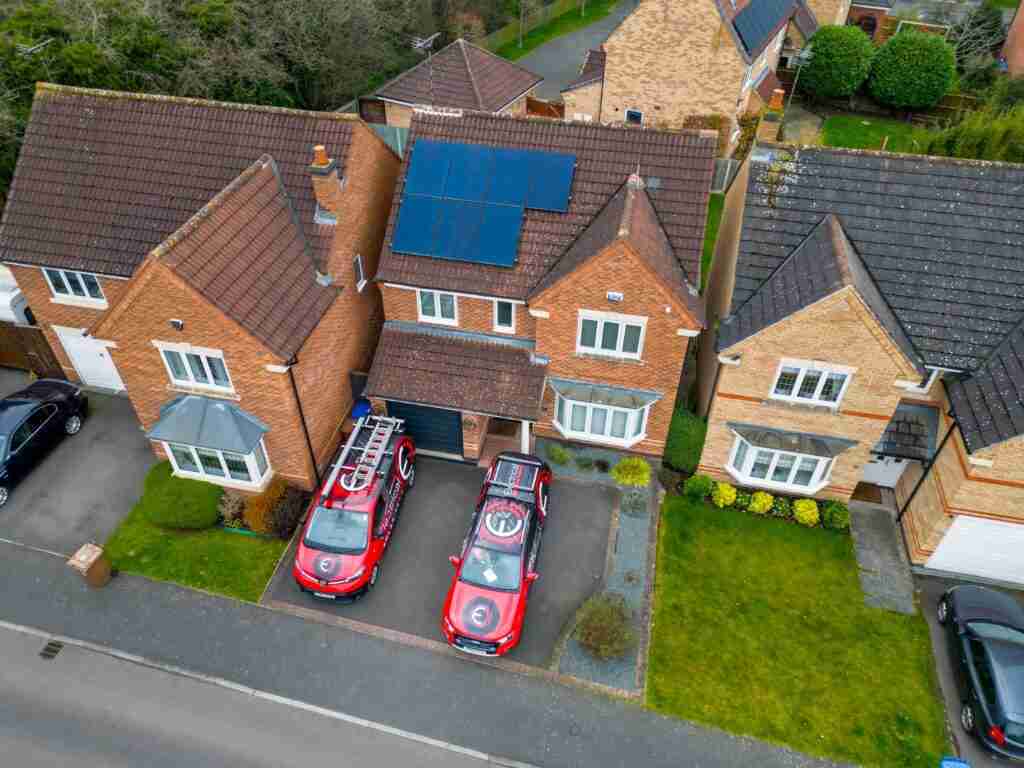
You don’t need a perfect south-facing roof to benefit from solar panels. Most UK homes can accommodate them and see good results, including properties with east- or west-facing roofs.
However, a solar installer, like our team here at Electrical Innovations, must assess more than your roof’s direction. Your available space, shading, roof condition, electrical installation and energy use will all determine what system suits your home. Read on to learn more.
Which direction does your roof face?
Solar panels generate the most electricity on an unshaded, south-facing roof. However, south-east and south-west roofs also perform quite well.
East-facing panels generate more electricity in the morning, while west-facing panels typically produce more later in the day. Depending on your needs and proposed setup, this could actually suit your routine.
A north-facing roof will generate less electricity. It doesn’t always rule out solar, but the predicted output may not justify the installation cost. If your home also has a usable south-facing roof section, we’ll normally prioritise it. Under comparable conditions, each south-facing panel should generate more electricity than an equivalent north-facing panel.
Does anything shade your roof?
Trees, chimneys, dormers and nearby buildings can block sunlight from reaching your panels. The effect will change throughout the day and across the seasons.
Some shade doesn’t make your home unsuitable. We may position panels elsewhere, divide the system between roof sections or use suitable equipment to reduce its effect.
A solar survey will help establish how much shade your roof receives and how it could affect your annual generation.
Do you have enough roof space?
A typical 3.5kWp solar system requires around 10m² to 20m² of roof space, although the exact area naturally depends on the panels we use.
Not all visible roof space will be available. We must allow for rooflights, chimneys, vents, edges and safe mounting positions.
If one roof section isn’t large enough, we may be able to divide the panels between different roof faces, install them on a garage or outbuilding, or consider a ground-mounted system.
Is your roof in good condition?
Your roof must support the panels, mounting system and forces created by wind and the occasional blast of snow. We’ll check its construction and look for damage, movement or alterations that could affect its strength.
You should also consider the remaining life of the roof covering. If your tiles, slates or membrane will soon need replacing, completing that work first could save you from paying to remove and reinstall the panels later.
Can you install solar panels on a flat roof?
You can install solar panels on many flat roofs. A mounting system holds the panels at an angle to improve generation and drainage.
Again, though, we must check the roof’s strength, waterproofing and exposure to wind. Ballasted mounting systems add weight, so the roof must support both the panels and ballast.
We’ll also leave enough room between rows to prevent one row from shading another.
Is your electrical system suitable?
Your solar panels connect to your home’s electrical installation, so we’ll assess your consumer unit, earthing, protective devices, incoming supply and metering arrangements. We’ll also identify suitable cable routes and locations for the inverter, isolators and any battery storage.
Older electrical equipment doesn’t necessarily prevent an installation. However, you may need upgrades before we can safely connect your solar system.
Can your system connect to the grid?
Your solar installation must be registered with your Distribution Network Operator (DNO). If you’re installing a larger system, it may need approval before we can install it.
The DNO may approve the proposed design, impose an export limit or request changes. An export restriction doesn’t necessarily prevent you from installing solar. We should be able to fit a compliant export-limiting device.
We’ll assess the proposed solar panels alongside any battery, EV charger or existing generation equipment. We also handle the application and paperwork on your behalf.
Do you need planning permission?
Most domestic rooftop solar installations in England fall under permitted development, so you won’t usually need to submit a planning application.
Additional restrictions may apply if you own a listed building or live in a conservation area, national park or World Heritage Site. You may need planning permission or listed building consent, depending on the property and proposed installation.
If you’re a tenant or leaseholder, you may also need permission from your landlord or freeholder before work begins.
Does solar suit your electricity use?
Your home may support solar panels, but the system must also suit how you use electricity.
You’ll normally save more when you can use the generated power during the day. Working from home, charging an EV or running appliances during daylight hours may increase your self-consumption.
If you don’t use all the electricity your panels generate, you may be able to sell the surplus through a Smart Export Guarantee (SEG) tariff. Alternatively, a battery can store unused electricity for later, although this adds to the cost. We’ll use your consumption and predicted generation to assess whether battery storage makes sense.
Get a solar system designed for your home
Electrical Innovations has served homes and businesses across Derby and the surrounding area since 2006.
We’re a family-run company, an NICEIC Approved Contractor, a TrustMark-registered business and an MCS-certified solar installer. Our team will assess your property and provide a system design with predicted generation and savings calculations.
Contact us today to schedule an assessment and find out whether solar panels suit your home.


