

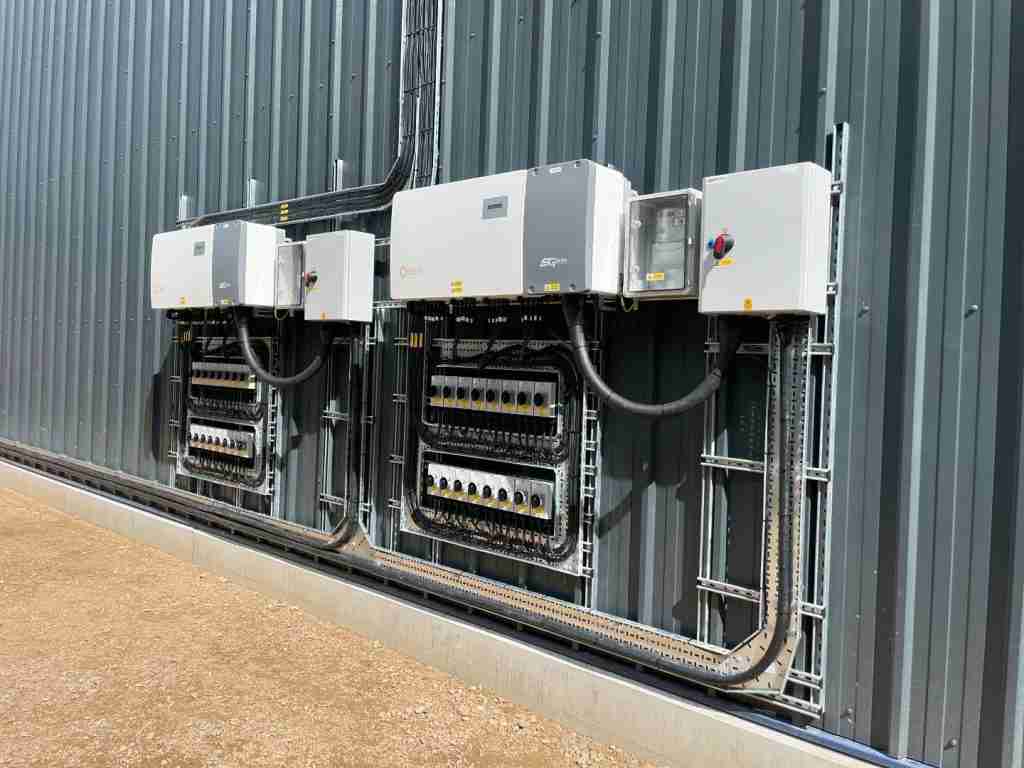
You’re comparing solar quotes for your property when something doesn’t seem to add up. One pairs a 4.5kWp panel array with a 3.68kW inverter. Is the inverter too small? Shouldn’t those figures match?
Not necessarily.
But that leaves an important question: how can you tell whether the installer has recommended the right inverter or one that could limit your system?
At Electrical Innovations, we design and install solar systems across Derby and the surrounding areas. Here’s how to understand inverter sizing and check whether an inverter suits your system.
What does solar inverter size mean?
Solar panels produce direct current (DC) electricity. The inverter changes it into alternating current (AC), which your home can use or you can export to the grid. If you’d like to understand the equipment first, read our guide to how solar inverters work.
An inverter’s size normally refers to its maximum AC output in kilowatts (kW), which is how much converted power it can deliver at one time.
Your panels have a separate rating in kilowatt peak (kWp), which describes their combined output under standard test conditions. Their real-world output changes with the light, temperature, roof direction, angle and shading.
Does the inverter size need to match the solar panel system?
No. Your panels won’t maintain their kWp output all day. Generation rises and falls with sunlight, temperature, roof direction, angle and shading, so the array will spend much of the year producing less than its rated peak.
If the inverter matched the array’s full kWp rating, you might only use that extra capacity when your panels reach their strongest peaks. In other words, you’d pay more for capacity that often sits unused. A slightly smaller inverter can often handle most of the electricity your panels produce over the year while keeping the upfront cost down.
So, what happens during those strongest peaks? If the panels produce more power than the inverter can convert, it simply caps its AC output. This is known as clipping. It may sound wasteful, but a small amount of clipping during occasional peaks will make little difference to your annual generation. If it happens often, however, the inverter could be too small.
That’s why the biggest inverter isn’t always the best choice. The goal is to find the right balance between cost and performance. Your installer should show you the expected annual generation, likely clipping and price of each option, so you can understand why they’ve recommended a particular size.
What determines the right solar inverter size?
No two homes generate and use solar electricity in quite the same way. That’s why your installer shouldn’t choose an inverter by looking at the panel rating alone. They should consider how the whole system will work together, including:
The panels: As well as considering their combined kWp, your installer will check their voltage, current and wiring arrangement to ensure they remain within the inverter’s input limits.
Your roof layout: A south-facing array may produce a stronger peak around the middle of the day. An east-west split tends to spread generation across more hours. As a result, two arrays with the same kWp rating may need differently sized inverters.
Battery storage: If a battery connects through the solar inverter, you’ll need a compatible hybrid inverter. Its charge and discharge limits affect how quickly the battery can store electricity and how much power it can supply to your home at once. An AC-coupled battery uses its own inverter instead.
Your plans: Thinking about adding more panels, an electric car or a heat pump? These could change how much electricity you generate and use. It’s worth planning ahead, although that doesn’t always mean buying a much larger inverter now.
Is 3.68kW the maximum inverter size for a UK home?
If your home has a single-phase electricity supply, which is the standard type found in most UK homes, you may hear that domestic solar inverters can’t exceed 3.68kW. In fact, this figure is a threshold that helps determine which grid connection process your solar system must follow.
For this purpose, the Distribution Network Operator (DNO) looks at the inverter’s registered AC output. This is the maximum output recorded for its connection to the grid. If your system has more than one inverter, the DNO considers their combined registered output.
At the UK’s nominal voltage of 230 volts, an output of 16 amps per phase corresponds to 3.68kW. If the registered inverter output is no more than this and the installation meets the other requirements, it can usually follow the simpler G98 process. Under G98, the installer completes the installation and then notifies the DNO. The DNO is the company responsible for your local electricity network, not the supplier that sends your bills.
Can I install a solar inverter larger than 3.68 kW?
Going above 3.68kW doesn’t mean you can’t have a larger inverter. It will normally bring the installation under the G99 process instead. Your installer applies to the DNO before installation, and the DNO checks whether the local network can accept the inverter’s proposed output.
The DNO may approve the inverter’s full output or set an export limit. This caps how much electricity your system can send back to the grid at one time. It doesn’t necessarily restrict how much solar electricity you can use in your home or send to a battery. Depending on the design, a larger inverter may still provide more power within your property while keeping grid exports within the agreed limit.
Your installer should manage this process and explain any restrictions before work begins. Our DNO-restricted solar installation in Melbourne, Derby shows how we paired a larger panel array with an inverter limited to 3.68kW.
How can you check the inverter size on your solar quote?
You’re not expected to work out the right inverter size yourself. However, a good installer should explain why they’ve recommended a particular model and what that choice means for your solar generation. If the quote doesn’t make this clear, ask:
Why have you paired this panel array with this inverter? The installer should explain how the roof layout and expected panel output affected the choice.
How much clipping do you expect? Ask how often it may occur and what difference a larger inverter would make to the predicted annual generation and installation cost.
Will the system suit a battery or future expansion? If you might add battery storage or more panels later, ask whether the inverter could support them or whether you’d need additional equipment.
Will the installation need G99 approval or an export limit? Your installer should explain whether the local grid affects the inverter size or how much electricity you can export.
Don’t judge the design by whether the two ratings match. What matters is whether the installer can explain how the chosen inverter balances cost, clipping and expected annual generation.
How can you check whether your current solar inverter is the right size?
Start by checking the inverter’s stated size. Find the make and model on its label, then look it up in the manual or on the manufacturer’s website. You’re looking for its rated or maximum AC output in kW. Don’t confuse this with the live output shown on the inverter or monitoring app, as that figure will change throughout the day. Your original quote or handover documents may also list the inverter’s rating.
Once you know the inverter size, compare it with the panel array’s capacity in kWp. You should find this on your quote, MCS certificate or handover pack. If it isn’t listed, multiply the wattage of each panel by the number of panels and divide by 1,000. For example, ten 450W panels make a 4.5kWp array.
Remember that a lower inverter rating doesn’t automatically mean it’s too small. Check your monitoring app on clear days as well. If the output often reaches the inverter’s rated limit and stays flat for long periods, regular clipping may be holding the system back. However, an export limit or inverter setting can create a similar pattern. Panels can also reach higher outputs in cool, bright conditions, so an occasional short flat peak isn’t necessarily a concern.
To know whether the inverter is the right size, ask a qualified solar installer to review the whole system. They can consider your roof layout, shading, panel wiring, inverter limits and export settings before estimating whether a different size would improve your annual generation. They can also check whether a replacement would suit your panels and electrical supply or require DNO approval.
Get the right solar inverter for your property
Choosing an inverter can feel like one of the more technical parts of planning a solar installation, but you don’t have to make the decision alone. Electrical Innovations is a family-run team that has served homes and businesses across Derby and beyond since 2006. As MCS-certified solar installers and NICEIC Approved Contractors, we’ll design your system around your property rather than recommend an inverter in isolation.
We’ll explain why the recommended inverter suits your system, what trade-offs you can expect and whether any grid restrictions apply. You’ll understand what you’re paying for and how the system should perform.
Explore our solar PV installation service to learn how we can help. If you’re planning a system in Derby or the wider Midlands, contact Electrical Innovations and we’ll talk you through your options.


